
Mar 2026Blog
The Lock-In Nobody Plans For
Most teams think vendor lock-in is an API problem. In agentic systems, it is usually a workflow and behavior problem.
When people talk about AI vendor lock-in, the conversation usually starts with model pricing and API compatibility. That matters, but it is only the visible layer.
A better analogy is cloud infrastructure. On paper, major clouds expose similar primitives. In practice, once a team deeply adopts one platform, migration is rarely trivial. The nuance lives in tooling, habits, and operational assumptions.
Agentic systems are heading toward the same pattern. Two providers can both claim coding agents, terminal access, and automation. But the way they run work can be fundamentally different.
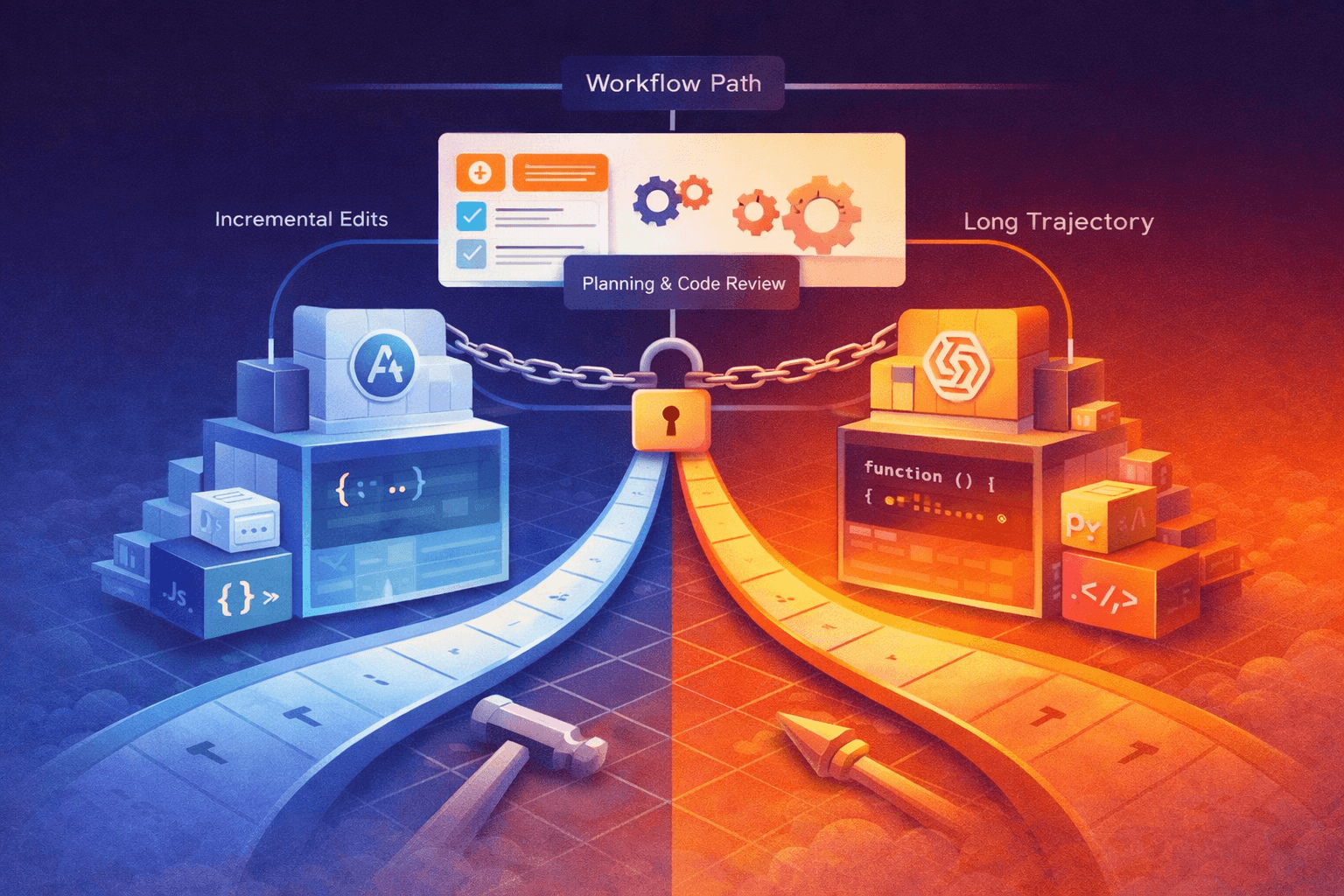
In one setup, the agent behaves more like an attended CLI collaborator: incremental edits, frequent feedback, and explicit permissions. Memory can live in local hierarchical files and project context that the team curates manually.
In another setup, the agent behaves more like a long-trajectory operator: parallel threads, broader intent interpretation, and longer autonomous runs before reconvening.
Those behavior differences leak directly into code. Some systems tend to add many helpers and compatibility shims and can over-engineer. Others tend to under-engineer, optimize for speed, and leave shortcuts that need later hardening.
This is the lock-in most teams underestimate. You do not just adopt a model. You adopt a way of planning, reviewing, and shipping. Over time, your team becomes optimized for that operating style.
So the practical strategy is not to avoid commitment. It is to avoid single-vendor assumptions at the workflow layer. Keep task contracts explicit, keep review standards model-agnostic, and test critical workflows with more than one agent path.
No one knows which provider or agent style will dominate in three years. Teams that keep optionality now will move faster later, because they can swap capability without rebuilding their operating system from scratch.